Engineering case study · Acquired by SIMCC
Maths Warriors
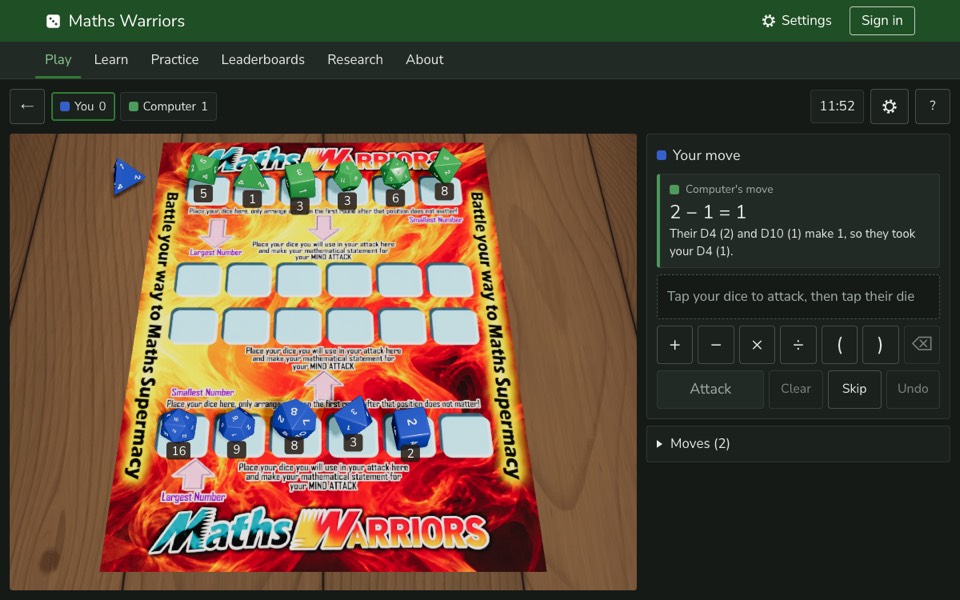
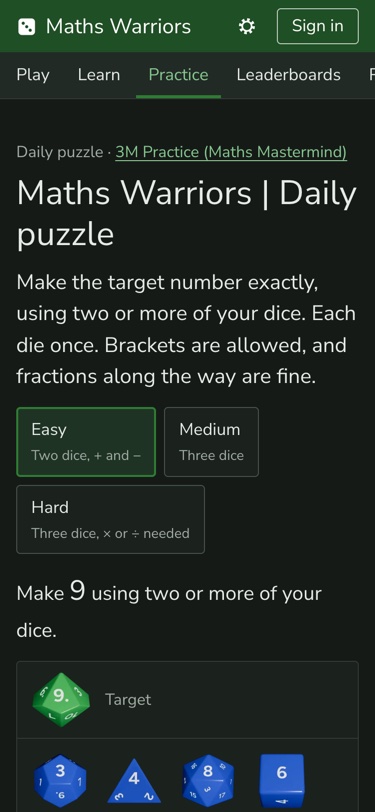
A full-stack mathematics game platform I built independently and sold to SIMCC Singapore. Played on a 3D table where the dice land on the values the rules engine decides, against AI opponents or live online, with Elo ratings and a daily puzzle.
TypeScript / React / three.js / Node.js / Supabase / WebSocket / Capacitor
The problem
A mathematics game needs consistent rules across its board, AI opponents, and multiplayer server. The platform also needed accounts, ratings, puzzles, and a mobile interface. I built the full stack independently, then continued development as a software engineering intern after SIMCC acquired the platform and its intellectual property.
Engineering decisions
- Built a seeded rules engine, arithmetic-expression evaluator, and minimax AI with alpha-beta pruning and difficulty tiers.
- Designed the engine as a pure (state, move) → state transformation with no DOM dependencies. This lets the rules run in headless node --test checks and survive a complete frontend migration.
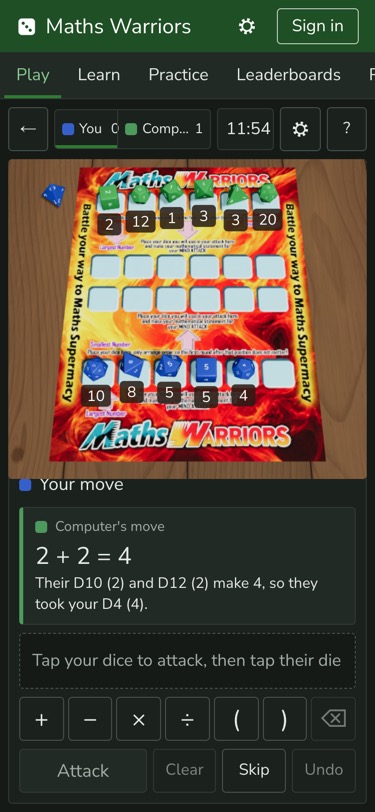
- Built a 3D table in three.js from the printed board and Blender-modelled dice. The engine decides every value; each die tumbles and lands on exactly that face, using face tables exported with the models.
- Kept the 3D table accessible: every die has a real button laid over it with the same name as on the flat board, so keyboard play, screen readers, and browser tests work unchanged. Reduced motion skips the tumble.
- Initially maintained separate client and server rules for authoritative multiplayer. After finding implementation drift, consolidated them into a shared package to eliminate that class of synchronization bugs.
- Rewrote approximately 3,900 lines of UI code in React and packaged the application for Android and iOS using Capacitor.
- Implemented native id-token authentication with a system-browser PKCE fallback, reconnect-with-backoff, deep links, hardware back integration, and content security policy controls.
The result
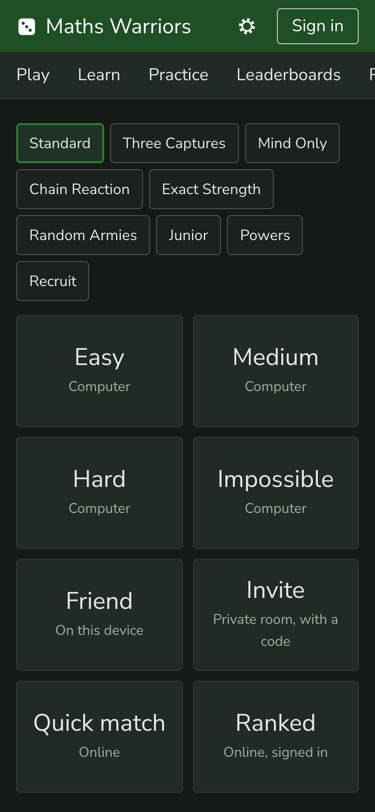
The platform was acquired by SIMCC Singapore. Games are now played on a 3D table built from the printed board, against four computer levels or online, in nine rule variants. Development spans the shared rules engine, React frontend, authoritative multiplayer server, and native mobile integrations. Android and iOS packages are built, with store release pending.
Explore the ideas
Interactive explanations of concepts behind this work: