Book · Draft edition · SIMCC
A Beginner’s Guide to Board Games
Design, build, test and share a game of your own.
A full-colour course book that teaches secondary school students to design, build, test, and present a board game of their own. Every chapter works through one broken example game, Market Day, and fixes a little more of it.
- Format
- A5, full colour
- Readers
- Students aged 12–17, and their teachers
- Structure
- 5 parts · 28 chapters
- Progress
- Chapters 1–6 drafted · 13,000 words · 19 figures
Look inside
Seven spreads from the first six chapters and the print-and-play pages. Click a page to see it full size.
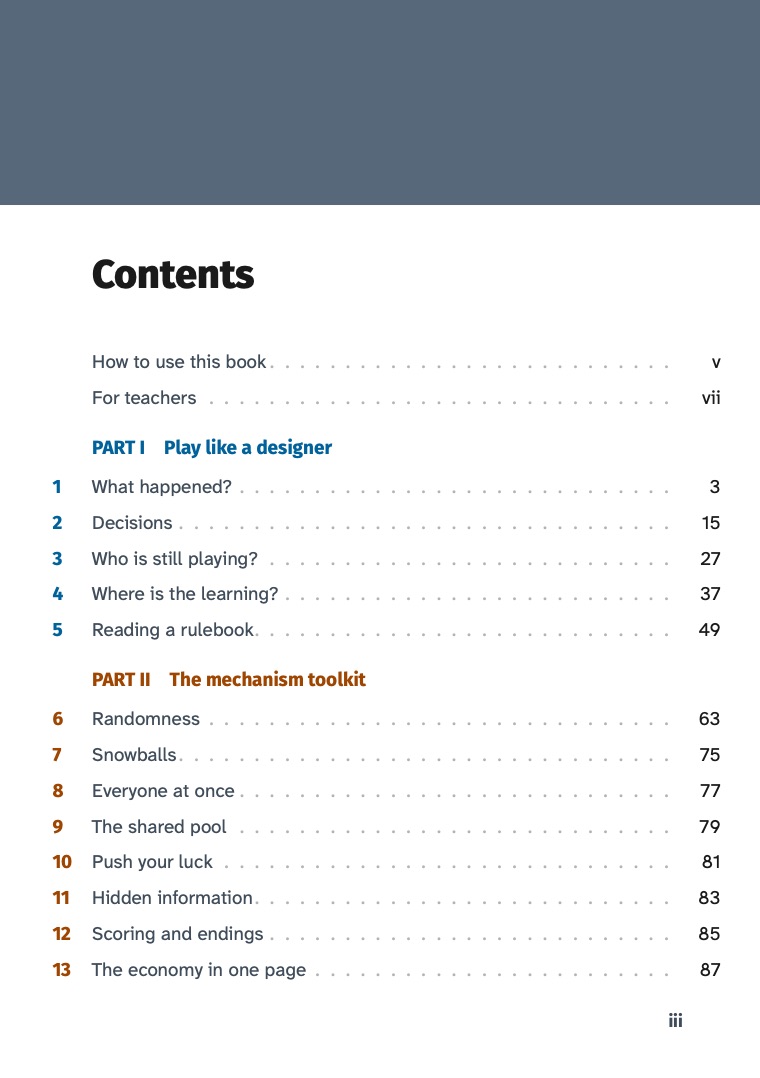
Contents
Part I
Play like a designer
Stop asking ‘was it fun?’ and start asking ‘what caused that?’
- 1What happened?Before you can fix a game, you need to know what actually happened in it.
- 2DecisionsA game is a string of choices. Some are real. Some only look real.
- 3Who is still playing?A game is only as good as it is for the player in last place.
- 4Where is the learning?A good game has more to learn than its rules.
- 5Reading a rulebookMost arguments at a game table start with one sentence in the rulebook.
Part II
The mechanism toolkit
How each mechanism works, what it does to players, and when to use it.
- 6RandomnessLuck is not the enemy of a good game. Luck in the wrong place is.
- 7SnowballsComing soon
- 8Everyone at onceComing soon
- 9The shared poolComing soon
- 10Push your luckComing soon
- 11Hidden informationComing soon
- 12Scoring and endingsComing soon
- 13The economy in one pageComing soon
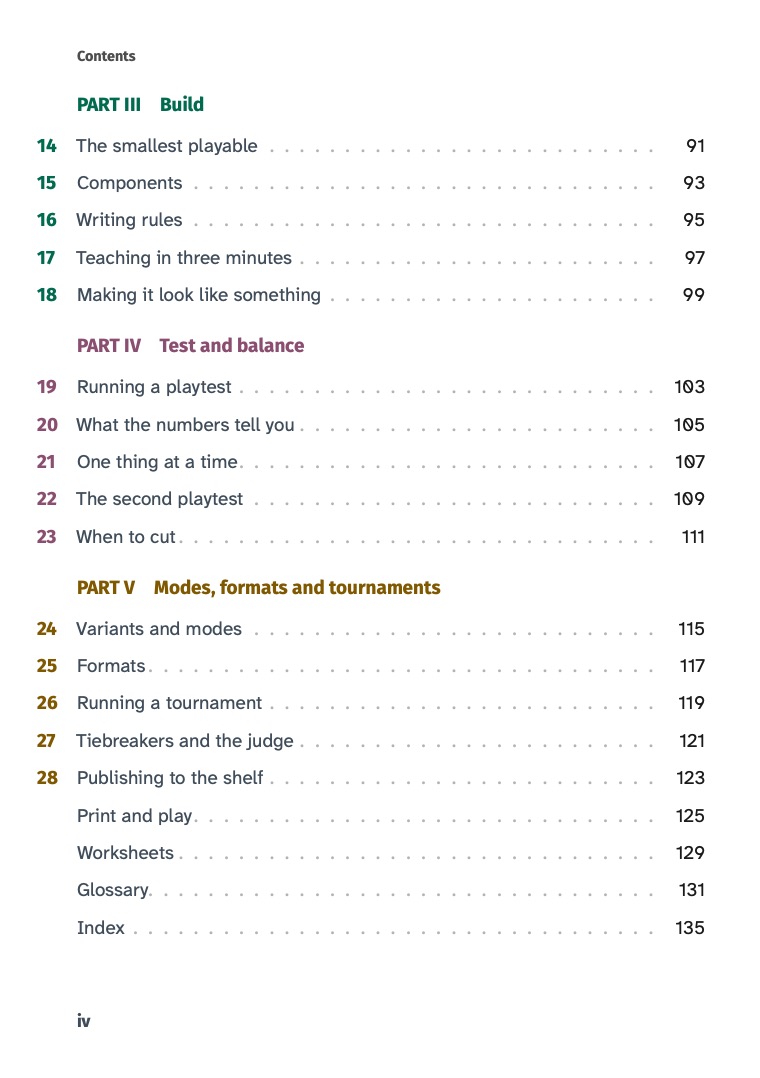
Part III
Build
Go from an idea to a game that people can play, learn and pick up.
- 14The smallest playableComing soon
- 15ComponentsComing soon
- 16Writing rulesComing soon
- 17Teaching in three minutesComing soon
- 18Making it look like somethingComing soon
Part IV
Test and balance
Evidence over opinion: test your game and let the results guide your changes.
- 19Running a playtestComing soon
- 20What the numbers tell youComing soon
- 21One thing at a timeComing soon
- 22The second playtestComing soon
- 23When to cutComing soon
Part V
Modes, formats and tournaments
Take your finished game out into the world.
- 24Variants and modesComing soon
- 25FormatsComing soon
- 26Running a tournamentComing soon
- 27Tiebreakers and the judgeComing soon
- 28Publishing to the shelfComing soon
How it’s made
The book is built like software: one source, automated checks, and numbers that can be reproduced.
- Typeset in LuaLaTeX with Atkinson Hyperlegible Next, a typeface designed for low-vision readers. Hyphenation is off, because whole words are easier for weaker readers and students learning English.
- Every number quoted about Market Day comes from a Python simulator, so each chance-of-winning chart can be reproduced exactly.
- Part colours come from the Okabe–Ito palette, and a script checks every text and background pairing against WCAG contrast. A greyscale contact sheet checks that nothing relies on colour alone.
- Style checks catch long sentences, American spellings, and straight quotes; a term checker makes sure every defined word appears in the glossary exactly once.